

Stop matching rewards by hand
Keep your existing REDCap protocol exactly as your IRB or ethics committee approved it. Keep paying participant compensation the way your study already does. Just automate the last step.
Without REWARDR
- Export the participant list
- Find their email
- Find an unused reward code
- Match the code to the participant
- Send the email by hand
- Update a spreadsheet
- Repeat for every participant
With REWARDR
- Survey completed
- Reward sent
- Everything recorded automatically
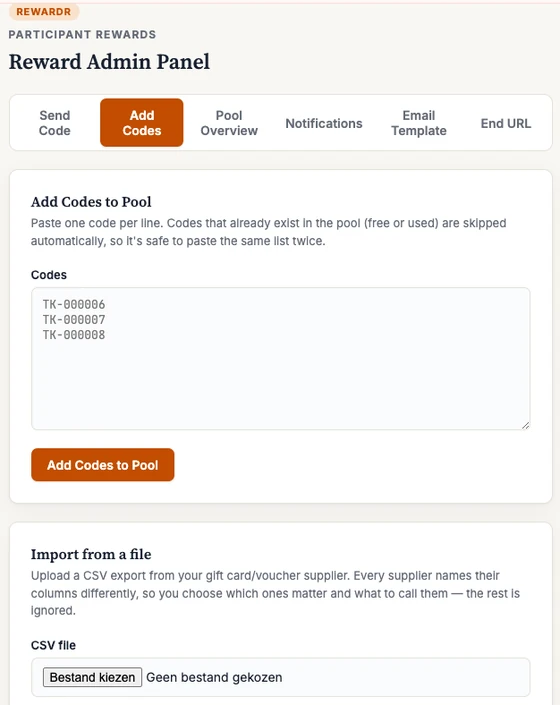
Import the rewards you already have
Every gift card or voucher supplier exports a different file. REWARDR doesn't force a fixed format on you.
No fixed column names required
Upload the export your supplier gives you — however its columns are labeled ("Card Number", "GC Number", "Voucher Code," anything) — and choose which ones should reach the participant.
Card number and PIN? Both, one email.
Combine several columns into one labeled reward — "Card number: X, PIN: Y" — exactly as your supplier issued it, no reformatting by hand.
Whichever way your REDCap project collects email — it adapts
Email comes from the project's own record
If your survey is tied to a REDCap record, piping [email] supplies the address directly in the Redirect to a URL address — nobody's asked for it again.
Email comes from their own answer
If the survey is a public (anonymous) REDCap survey, an email question simply asks for an address to send the reward to — leaving it blank is treated as "no thanks," not an error.
An honest thank-you page, every time
Three distinct, plain-language outcomes — never a confusing technical error shown to a participant.
Reward sent
"Your code is on its way to your inbox." Shown once for a new code, and again (worded as a resend) if this participant already has one — never a second, different code.
No reward requested
The participant left the optional email question blank — they're still thanked warmly, with no mention of a code they never asked for.
Something needs a human
An invalid email, or a code that couldn't be generated — the participant is asked to get in touch, rather than being shown a raw error.
Choose exactly what reaches REWARDR
Many IRBs and ethics committees want a clear answer to "does the reward system ever see participant identity?" With REDCap, you choose the answer per study.
REWARDR emails the code directly
The participant's email is piped into the redirect and reaches REWARDR just long enough to send one message — it's never stored as part of your study's record data.
REWARDR never receives an email address
Only REDCap's own [record-name] is passed — the same reference REDCap already uses internally. The code appears directly on the completion page; no email address of any kind ever reaches REWARDR's server.
Only what's needed to send one email
The page REDCap's Redirect to a URL setting points to only ever does one thing with the email address it receives: assign a reward code and send it. It doesn't become part of your survey's response data, and the link itself can't be reused by anyone who didn't come from a real, completed REDCap response.
- The redirect URL is signed with a shared secret — a guessed or copied link without it is rejected outright.
- A participant can never accidentally receive two rewards — submitting twice just returns their same code again (technically: reassignment is idempotent).
- Declining to give an email (on an anonymous survey) is treated as a normal, valid outcome — not logged as an error.
- Nothing is stored beyond what's needed to avoid double-issuing a code — no participant list, no survey answers.
- Runs entirely outside your REDCap project — nothing here becomes part of the data your IRB or ethics committee reviewed.
Not a REDCap external module — it just reads your redirect link
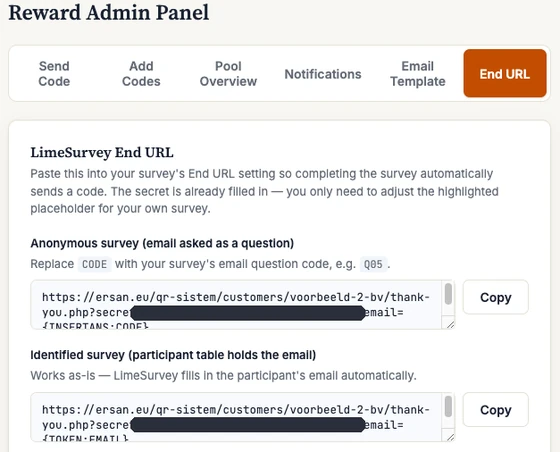
This never talks to REDCap through an API — it only needs the Survey Termination Options → Redirect to a URL setting every REDCap survey already has, with the participant's email piped in via [email]. Running other tools alongside REDCap? The same setup works for these too:
| Survey platform | Support | Where to set it |
|---|---|---|
| LimeSurvey | ✓ Native | Survey → End URL, with {yourquestioncode.NAOK} or {TOKEN:EMAIL} |
| Qualtrics | ✓ Native | Survey Flow → End of Survey → "Redirect to a URL", piping ${e://Field/email} |
| REDCap | ✓ Native | Survey settings → "Redirect to a URL" on completion, piping [email_field] |
| Castor EDC | ✓ Native | Invitation settings → Finished URL, piping {your_email_field} |
| SurveyMonkey | ✓ Native | Collector → Survey End Page redirect, with a custom variable |
| Typeform | ✓ Native | Endings → Redirect to URL, recalling a hidden field into the URL |
| Tally | ✓ Native | Form Settings → Redirect on Completion, inserting the Submission ID via the field picker |
| JotForm | ✓ Native | Thank You Page → redirect to external URL, piping {id} |
| Google Forms | ⚠ Workaround | No native auto-redirect — a clickable link in the confirmation message, or an Apps Script embed |
- Reads the participant's email straight out of the end URL's own query string — no separate integration to maintain.
- Runs as a small, self-contained script on your own server — nothing to install on the survey platform itself.
- The reward-code logic (how codes are generated, what triggers a resend) is written once and reused for every survey wave.
A small admin panel, for the moments automation isn't enough
Everything above runs on its own — this is for the handful of times a coordinator needs to look something up or fix something by hand.
Send a code by hand
If a participant's automatic trigger didn't fire for some reason, look up their email and send their code manually — same "never a duplicate" logic applies, so it's always safe to try.
Paste in a new batch of codes
Adding another batch of reward codes is one paste, one click. Anything already in the pool — free or already used — is skipped automatically, so re-pasting a list by accident never causes duplicates.
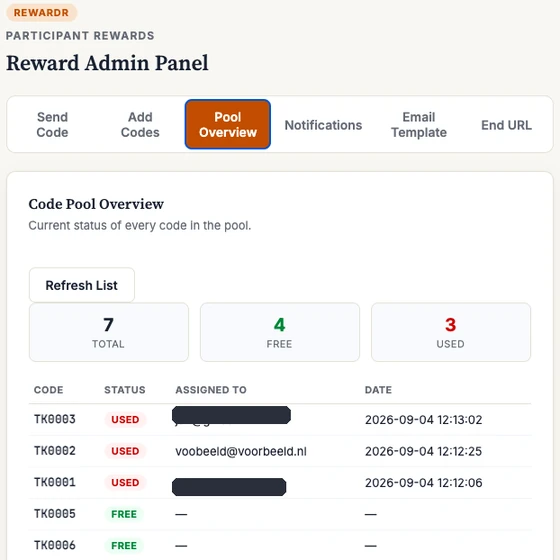
See exactly what's left
A running count of free vs. used codes, and a full table of every code, who it went to, and when — so "are we about to run out?" is always a glance away, not a spreadsheet search.
Get warned before the pool runs dry
Whoever's managing the study can add or remove their own email from a short notification list — they hear about every code sent out, and get an early warning once the pool is running low.
REDCap reward delivery — questions we get
Does REWARDR require a REDCap module?
No. It only needs the "Redirect to a URL" option under Survey Settings → Survey Termination Options — a native REDCap setting. There's no external module and no API integration to build.
How do you stop the same REDCap response from claiming two rewards?
Two layers. Piping [record-name] — REDCap's own Smart Variable for that record — into the redirect means a captured link can't be replayed with a different email to mint extra codes. On top of that, the same email address is only ever assigned one code.
Does this work with an anonymous REDCap survey?
Yes. Add a field asking for an email address just for the reward, and pipe that field's own name into the redirect. Leaving it blank is treated as no reward wanted, not an error.
Can I skip collecting an email entirely?
Yes — On-screen delivery mode shows the code directly on the survey's completion page, using [record-name] as the reference instead of an email address. No participant email ever reaches REWARDR in that mode.
What does REWARDR cost for a REDCap project?
Priced per participant — from €0.75 to €1.50 depending on volume, with no minimum and no separate plans to pick between.
Do I need IRB approval to mention the reward this way?
That depends on your protocol, not on REWARDR — if the survey invitation itself references a gift card or other incentive, most IRBs expect that disclosure to already be covered in your approved consent materials, the same as any other compensation method. REWARDR doesn't change what participants are told; it only automates sending what your protocol already promises.
Tell us about your survey
If completing your REDCap survey should unlock a reward — a test kit, a voucher, anything redeemable by code — this is built to handle exactly that, automatically. A few details and we'll get back to you.